Properties bordered by mature tree canopies and drainage tributaries require specific perimeter interception to control vector insects. Tick and mosquito perimeter suppression in Blacklick, OH delivers targeted…
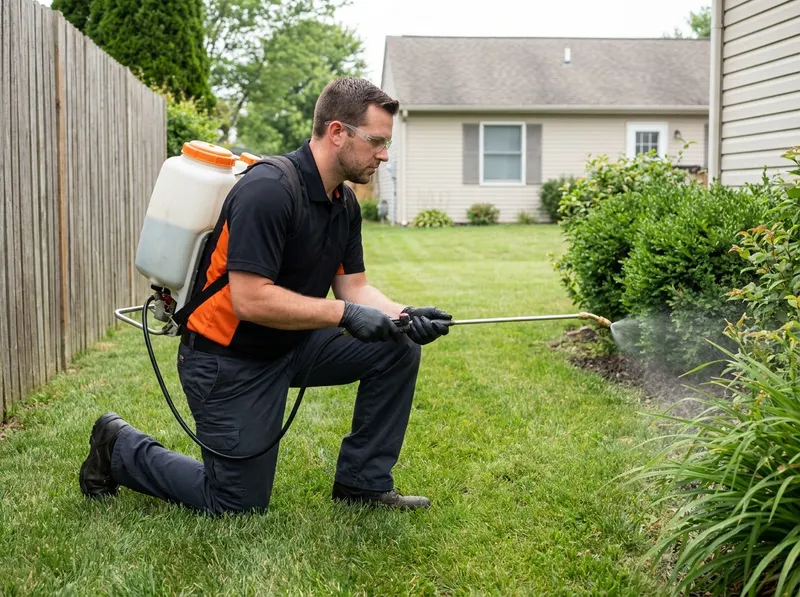
Properties bordered by mature tree canopies and drainage tributaries require specific perimeter interception to control vector insects. Tick and mosquito perimeter suppression in Blacklick, OH delivers targeted microencapsulated applications along shaded property boundaries rather than indiscriminate blanket spraying across open lawn surfaces. Vector-borne risks, including Lyme disease documented by the Centers for Disease Control and Prevention and West Nile virus monitored by the Ohio Department of Health, originate primarily in the dense transition line where maintained turf meets wild brush. Properties in neighborhoods like Woods at Jefferson and Saddle Run feature dense brush edges that shelter white-tailed deer and rodents, the primary hosts for tick nymphs, while shaded, moist corridors near Taylor Woods and Blacklick Woods Metro Park create ideal resting zones for adult mosquitoes.
Technicians treat the underside of broadleaf shrubs, groundcover beds, and woodline interfaces where adult mosquitoes rest during daylight hours, complying with pesticide distribution standards overseen by the Ohio Department of Agriculture. For aquatic mosquito larvae breeding in unmovable standing water, such as woodland drainage ditches near Havens Corners or retention ponds around Broadview Heights, technicians place target-specific biological larvicides containing Bacillus thuringiensis israelensis as regulated by the US Environmental Protection Agency. This organism specifically targets larval gut receptors without harming beneficial pollinators or aquatic invertebrates. Tick control involves establishing a granular or liquid barrier across leaf litter corridors, drawing upon habitat management protocols from the Purdue University Extension Entomology network and research published through the Journal of Medical Entomology.
Selecting a perimeter suppression program depends heavily on parcel topology and tree density. A traditional broad-spectrum perimeter treatment fits sprawling single-family acreage in Jefferson Run or Pinecrest where heavy tree buffers generate continuous tick drift, whereas compact parcels in Blacklick Ridge benefit from focused harborage modification and physical brush reduction. The trade-off centers on residual persistence versus environmental footprint: synthetic microencapsulated pyrethroids offer 21 to 30 days of weather-resistant suppression against summer rain, while plant-based essential oil solutions provide a lower persistence profile that requires reapplication every 14 to 21 days during high-heat periods. Every protocol respects national safety directives from the National Pesticide Information Center, and technicians follow integrated pest management principles outlined by the USDA National Institute of Food and Agriculture, the Entomological Society of America, and the American Mosquito Control Association.
Every job gets a firm, written price after an on-site visit.
Tell us about your tick and mosquito perimeter suppression job in Blacklick and we'll send a clear, written quote, usually the same day.
 ForestVale Pest Response