ForestVale Pest ResponseForestVale Pest Response

Rodent Control and Exclusion Blacklick

Rodent control and exclusion in Blacklick, OH addresses active rodent intrusions through physical architecture reinforcement rather than temporary bait placements. In residential settings across Jefferson Run,…
Get My Estimate →(380) 255-6028
Rodent Control and Exclusion in Blacklick, OH
Quick answer
  • Complete structural inspection identifying gnaw points, roof transitions, and foundation sill gaps across the entire exterior footprint.
  • Mechanical trapping alongside exterior physical sealing using galvanized steel hardware cloth and exterior-grade backing compounds.
  • On-site diagnostic visits start at the baseline minimum charge of $200, with comprehensive exclusion repairs priced directly on structure scope.
  • Targeted eradication covers domestic house mice (Mus musculus) and Norway rats (Rattus norvegicus) without recurring chemical subscriptions.
  • Direct service dispatch is available Monday through Saturday across Franklin County by calling (380) 255-6028.

Rodent control and exclusion in Blacklick, OH addresses active rodent intrusions through physical architecture reinforcement rather than temporary bait placements. In residential settings across Jefferson Run, Broadview Heights, and Saddle Run, house mice exploit utility pipe penetrations, louvered gable vents, and sill plate expansion joints. Mice require an opening of only 6 millimeters, roughly the diameter of a standard pencil, to squeeze into wall voids, while Norway rats can breach gaps as narrow as 12 to 20 millimeters. Once inside, chewing behaviors driven by constantly growing incisors create severe structural risks. According to the National Fire Protection Association, unaddressed rodent gnawing on electrical wire insulation causes hidden electrical arcs that trigger residential structure fires. Physical exclusion ends this hazard by blocking exterior access, whereas routine exterior chemical baiting merely culls a fraction of the outside population while leaving the home open to subsequent breaches.

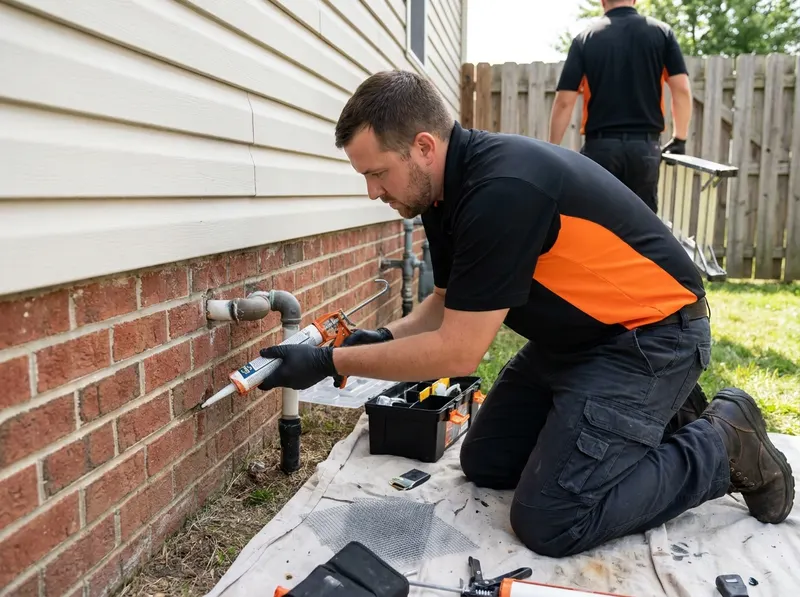
Technicians resolve structural vulnerability through multi-stage physical remediation. Field evaluations assess foundation transitions, corner-post caps, garage door astragal seals, and roof return valleys. The Centers for Disease Control and Prevention documents that sealing structural apertures with durable materials like hardware cloth prevents pathogen transmission, including lymphocytic choriomeningitis and hantavirus. Technicians seal low-clearance expansion zones with 19-gauge hot-dipped galvanized steel mesh paired with elastomeric caulking that resists continuous gnawing pressure. In tree-lined subdivisions such as Woods at Jefferson and Pinecrest, roofline gaps where fascia boards meet sub-roof decking are secured with tailored metal drip flashing. For properties near agricultural borders along Havens Corners and Blacklick Ridge, foundation weep holes receive breathable metal inserts that allow wall moisture ventilation while denying pest access. This physical remediation is accompanied by targeted interior mechanical trapping inside enclosed zones, removing existing populations without discharging unsecured broadcast chemicals inside family living areas.

Property remediation follows a methodical five-stage sequence to guarantee that rodents are trapped out while new invaders are physically locked out. Homeowners can reach technicians at (380) 255-6028 to review timeline parameters before repairs commence:

  1. Step 1 Exterior perimeter mapping: Technicians examine the full structure from foundation footing to roofline trim, recording every opening larger than one-quarter inch.
  2. Step 2 Mechanical trap deployment: Enclosed snap traps are positioned in locked attic spaces, basements, and utility chases away from children and domestic pets.
  3. Step 3 Architectural exclusion barrier installation: Technicians fasten 19-gauge steel hardware cloth, metal flashing, and structural seals to all identified breach zones.
  4. Step 4 Population monitoring and retrieval: Traps are checked and cleared over consecutive visits until zero rodent movement or snap triggers remain.
  5. Step 5 Attractant and sanitation mitigation: Fecal deposits are treated according to biological standards, and thermal attic insulation depth is assessed for disruption.

Choosing full exclusion over basic monthly poison plans involves a clear operational trade-off. Simple bait stations placed along a foundation cost less initially, but they fail to stop new mice from entering cold attics during October temperature drops, and decomposing rodents can perish out of reach within interior drywall bays. Comprehensive exclusion demands a higher upfront investment to structurally modify building transitions, but it delivers permanent physical isolation that protects electrical wiring and blown cellulose insulation over the multi-year life of the house. For homes near Taylor Woods facing seasonal rodent influxes, physical exclusion serves as a permanent architectural repair.

How much does Rodent Control and Exclusion cost in Blacklick?

Initial Diagnostic Inspection and Basic Mechanical Trapping Setup$200 to $325
Foundation Penetration Sealing and Low-Level Gap Exclusion$350 to $650
Comprehensive Whole-Home Rodent Exclusion (Roofline, Vents, Foundation)$850 to $2,200
Attic Bio-Sanitation and Localized Soiled Insulation Cleanout$500 to $1,800

Every job gets a firm, written price after an on-site visit.

Common questions

How much does rodent control and exclusion cost in Blacklick?
Rodent control and exclusion in Blacklick starts at a $200 minimum diagnostic fee, while full exclusion projects involving extensive roofline metal repairs, crawl space sealing, and trap monitoring generally run between $850 and $2,200 depending on total exterior linear footage.
Are rodent control treatments in Blacklick safe for households with pets?
Mechanical exclusion and trapping methods prioritize pet safety by placing all capture devices inside sealed tamper-resistant stations or sequestered structural cavities like attics, completely eliminating the need for open indoor poison pellets.
How fast can technicians inspect a home for rodents in Blacklick?
Diagnostic inspection visits in Blacklick are scheduled within 24 to 48 hours of initial inquiry, providing prompt mapping of attic entry pathways and active wall noises across neighborhoods like Broadview Heights and Jefferson Run.
Does rodent exclusion require signing an ongoing quarterly pest contract in Blacklick?
Rodent exclusion operates as a standalone corrective service focused on permanent physical repairs, meaning homeowners are not forced into signing long-term quarterly chemical maintenance contracts for a one-time entry issue.
What materials are used to seal rodent entry points around Blacklick homes?
Technicians secure breach points using rust-resistant 19-gauge galvanized steel mesh, solid aluminum flashing, heavy-gauge copper mesh packing, and specialized chew-proof exterior backing polymers that rodents cannot gnaw through.

Get started today

Tell us about your rodent control and exclusion job in Blacklick and we'll send a clear, written quote, usually the same day.

Get your PEST CONTROL SEVICE quote, Blacklick

We only use your ZIP to check availability, no spam.